The attribution challenge: How do you prove the ROI of place branding?

By Clare Dewhirst, Director, City Nation Place
“Half the money I spend on advertising is wasted; the trouble is I don’t know which half.”
There’s nothing like starting an article with a cliché to grab attention, but there’s a reason that American retail entrepreneur John Wanamaker has been so over-quoted. It’s always been a challenge to provide unarguable attributed ROI on marketing and advertising spend. And if it’s difficult for FMCG and other consumer brands, then it’s even more difficult for place brand and marketing teams.
The evolution of advertising from John Wanamaker’s day [the end of the 19th century] to now has borne with it many promises of improved attribution for advertising spend. The advent of the internet and of digital advertising was initially celebrated for its ability to track consumer journeys from website to e-commerce platform. But over time, the decline of the third-party cookie means that marketers have lost a chunk of that trackable data; ad platforms operating in silos has led to duplicate reporting and inflated ROI; and consumers complicate their decision-making journeys further, first by using multiple devices and now, of course, by using AI tools to do their research for them.
Navigating the dark funnel
A new movement called “Advertising: Who Cares?” was started in the UK in 2025 by two seasoned industry leaders who have essentially called out the emperor’s new clothes: a lot of digital advertising is badly targeted, with poor creativity, and the agencies and tech platforms don’t care enough about this. The first conference hosted by this movement drew some conclusions for marketers which are very applicable to the world of place – particularly as we begin exploring attribution in place branding specifically. Summed up in a Media Leader article, their first observation is that there is an "overemphasis on short-term results, as if the purpose of advertising were only to sell something today.”
Sound familiar? Another conclusion was that the advertiser business model needs to change: “marketing and advertising should evolve as an integrated approach… a ‘whole body’ process that takes into account the various elements… with a single objective."
With the movement’s pure advertising focus, this is a suggested response to what marketers have called the “dark funnel”, where over 70% of buying decisions are made before someone clicks a traceable link: word of mouth, media coverage, outdoor advertising, and personal experience all play a part.
Given the complicated relationships people have with places, this “dark funnel” is even more relevant in the world of place branding. It’s why place brand experts emphasise the value of a place-led approach – a unified narrative with a unified voice. And it’s also why it is so difficult for place branding teams, destination marketing organisations, investment promotion agencies, and economic development teams to prove that it’s their actions and their work that are having the impact on perceptions of place and willingness to live, visit, and invest.
Place brand attribution in action
London & Partners, the organisation responsible for managing the international reputation of the UK’s capital, also has the marketing remit to grow tourism and increase investment. At the 2024 City Nation Place Global conference and in our 2023 benchmarking report, Solving the Measurement Challenge, we learned how the team only claims credit where they have evidence that their marketing has had an impact. For example, only counting visitors who arrived after the start of a campaign, who said they’d seen the campaign, and even then only those who could correctly identify having seen the campaign on a channel where it had actually appeared! They also asked survey respondents to what extent the campaign had influenced their decision to visit and only counted the average share that visitors attributed to the campaign. This approach means that while the numbers they report to stakeholders are smaller than they could be, the team are absolutely confident that they’re representing the value they have specifically added to the London economy.
For our 2025 Place Brand KPIs Report, we asked what data is being gathered to demonstrate the impact of place branding work, and as the chart below suggests, London & Partners are in the minority when it comes to place teams running surveys to model attribution for visitor numbers, events booked, investment leads, or talent and student arrivals.
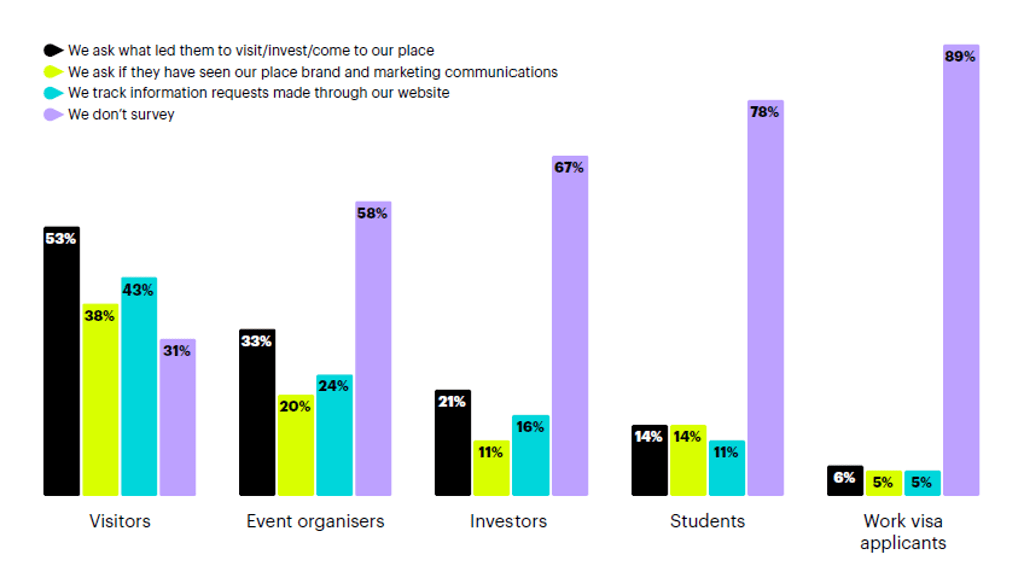
At our recent CNP Lab event in Lisbon, the delegation spent time focusing on the changing decision-making journeys for visitors, investors, and talent and how this necessitates thinking about place marketing KPIs differently. In our post-event summary of the discussions, Steve Duncan of C Studios analysed the challenge when place promotion organisations are asked that simple question: “what results did your marketing deliver?”
Lazy KPIs will talk about how many investment leads were generated, how many people relocated, how many people booked a trip – measurable numbers to justify budgets. But as Steve says, “the challenge is that these outcomes prioritise the end of a decision process, whereas place marketing’s strongest value comes much earlier."
How do you actually measure changes in perception or reputation?
We know that perception of place impacts on the willingness to visit, invest, or migrate from a project we worked on with Bloom Consulting, which puts an economic value on how the perception of your place impacts upon its economy. This demonstrates the importance of your work to manage your place brand but again doesn’t provide you with the attribution you need to demonstrate that your team is doing a good job and merits continued support.
Place teams are not selling a product over which they have sole control; they are building the reputation of their nation, region, city, or place. They are working to create or change perceptions of the place, with multi-pronged strategies, across multiple initiatives, working with a plethora of stakeholders, and often against a backdrop of established public opinion.
So how do you measure that?
If you are a larger nation or city, then there are a number of brand and soft power rankings that will benchmark your place reputation. Back in 2023, we created a guide to place rankings, as they do all measure slightly different things. These rankings, the research behind them, and the strategic advice that can come with them, can undoubtedly add value to place branding work. However, they are easily misinterpreted by government and other stakeholders; it’s all too easy for egos to get involved when a ranking improves or decline, regardless as to whether it’s relevant to current agreed objectives for the place brand. And of course, whilst understanding how your place is perceived can guide your strategy, the rankings can’t attribute a shift in perception to your work specifically when so many other factors influence perception.
Lessons in attribution from Eindhoven and Tasmania
If your organisation is to secure stakeholder and financial support to fund your long-term place brand strategy and to survive the vicissitudes of government, you need to establish other KPIs that are more relevant to your remit and your objectives.
For a place brand team to demonstrate attribution, you need to have very clear and detailed objectives beyond improving and managing the reputation of place, growing tourism, or growing investment. The clearer your objectives, the easier it is to break these down into what can be measured and attributed to your work.
As one example, Eindhoven 365, the marketing organisation for the fastest-growing economic region in the Netherlands, has identified an evolution in its purpose and approach which is ratified by the city council. In its 2022-2030 strategy document, it describes this as evolving from brand developer to brand activator to brand connector. They are shifting emphasis from attracting new people and investment to connecting established and incoming citizens so that everyone has a positive experience of the city and is happy to be an ambassador for Eindhoven’s “why here”, thus affirming its growing reputation.
This clear-sighted vision enables the team to arrive at very measurable and attributable KPIs. For example, one of their objectives is to integrate newcomers. In line with this, the team have identified that “We can consider it a success if by 2025 we have established an international culture club with a minimum of 5,000 members comprising current residents and newcomers." Yes, this is measuring activity, but it is a directly attributable activity linked to a specific vision for the city.
In conversation with Jess Radford of Brand Tasmania recently, she shared the six objectives of her organisation’s work, again as ratified by their government. The team are there to ensure that the Tasmanian brand, which differentiates and enhances Tasmania’s appeal and national and international competitiveness, is “developed, maintained, protected, promoted, strengthened, and that the Tasmanian brand is a key asset of the community”.
Every action they take is linked to these objectives and measured against them. But even more importantly, the team are focused on demonstrating that their organisation is an efficient and cost-effective service provider. They ask themselves, does this organisation deliver more than it costs? Do stakeholders think the organisation delivers value? Does the organisation deliver on its purpose?
As Jess says, “When we think about impact, we are measuring whether our work created meaningful change for Tasmania by influencing awareness, capability, behaviour, and participation, and whether our projects and outputs contributed to the long-term strength, reputation, competitiveness, appeal and value of the Tasmanian brand."
Proving the value of place branding
In a world where accurate advertising and marketing attribution continues to be elusive, we recommend that place brand and marketing teams stop relying on marketing performance indicators to demonstrate the value of their work. It’s time to be bolder, to be more confident about the contribution of place branding work, to ask the difficult questions, and to provide stakeholders with a better understanding of impact.
To that end, we’re launching a new study to look at how places are tracking domestic and external perceptions of their city, region, or nation, and we invite you to share your own experience with us as we develop this free resource for the wider place branding community.
We look forward to sharing the results with you at the Global conference in November.