




The Reputation of the World’s 60 Largest Economies Declines in 2026
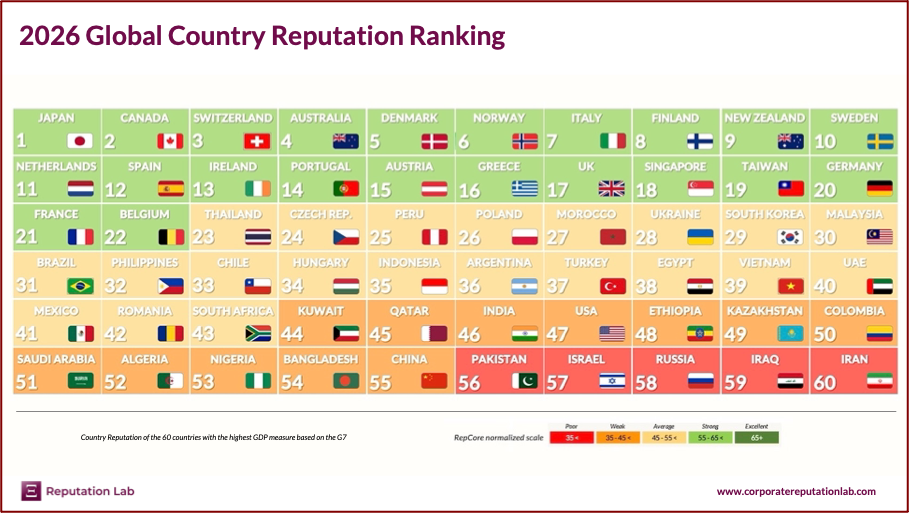
Japan rises to first place in the RepCore® Nations ranking after climbing seven positions and overtaking Canada and Switzerland
The international reputation of countries has weakened over the past year amid growing geopolitical uncertainty, armed conflicts, political polarisation and economic slowdown. This is one of the main conclusions of RepCore® Nations 2026, the analysis developed by Reputation Lab that evaluates the reputation of the world’s 60 largest economies based on the views of the general public in G7 countries (the United States, the United Kingdom, France, Germany, Italy, Japan and Canada). View the recording of this webinar, where the results were presented live. The average reputation of the 60 countries analysed declined by 0.86 points compared to the previous year. The findings reflect a broad-based decrease in the levels of admiration, respect and trust that countries generate among international audiences. Of the 60 economies analysed, 43 experienced a decline in their reputation indicator, 14 improved and only 3 remained stable.
- The average reputation of the world’s 60 largest economies declines by 0.86 points compared to the previous year, reflecting a widespread deterioration in the admiration, respect and trust that countries generate among international audiences.
- Japan, China and Russia record the largest improvements in international reputation in 2026, although China and Russia continue to rank at weak or poor reputation levels.
- Stable democracies continue to dominate the top positions in the ranking, led by Japan, Canada, Switzerland, Australia and Denmark.
- Israel records the largest reputational decline in the analysis. Since 2022, it has lost 15.75 points and fallen 20 positions in the ranking.
- The new Made-In Score confirms that a country’s reputation has a direct impact on perceptions of its products and services and on consumers’ willingness to pay a premium for them.
Japan Takes the Global Lead
The most significant development in the 2026 ranking is Japan’s rise to first place in the global classification. The country climbs seven positions compared with the previous year and overtakes Canada and Switzerland thanks to the outstanding evaluations it receives for the quality of its products and services, its cultural attractions and cuisine, safety, education system, natural environment and the perception of its citizens as educated and reliable people. Over the past year, Japan has also improved significantly in attributes related to institutional quality.
Following Japan, the top ten is completed by Canada, Switzerland, Australia, Denmark, Norway, Italy, Finland, New Zealand and Sweden. The results once again show that the countries with the strongest international reputations are, for the most part, stable democracies capable of generating high levels of admiration, respect and trust among their stakeholders.
The Erosion of Country Reputations
Beyond individual country movements, the main conclusion of the 2026 edition is the widespread deterioration in the international reputation of countries.
Japan, China and Russia record the largest improvements in reputation over the past year. However, China and Russia continue to rank at weak or poor reputation levels among citizens of the world’s most developed economies.
By contrast, Israel records the largest reputational decline in the analysis. In the last year alone, it has lost 7.2 points and fallen two positions in the ranking. Since 2022, its reputation has declined by 15.75 points and it has dropped 20 positions, from 37th to 57th place. The results reflect the significant impact that international criticism related to human rights in Gaza, as well as the expansion of military tensions to other regional theatres such as Lebanon and Iran, has had on the country’s international standing.
Iran also continues to see its reputation deteriorate from what was already one of the lowest levels in the world. The current military conflict and growing regional tensions have further worsened an already very negative perception among international audiences. As a result, Iran now occupies the last position in the ranking and is overtaken even by Russia, which had finished last in each of the previous four editions of RepCore® Nations.
Among the major powers, the United States shows no signs of recovery following the sharp reputational decline recorded in 2025. After last year’s fall, the country continues to hold a weak reputation among G7 citizens, confirming that international visibility and influence do not necessarily translate into admiration, respect and trust.
Indeed, the United States, China and Russia are among the best-known countries in the world, yet they continue to register weak or poor reputation levels. At the opposite end of the spectrum, countries such as Singapore and Taiwan achieve strong reputations despite significantly lower levels of familiarity among international audiences. The results confirm that international visibility may generate attention, but not necessarily admiration, respect and trust.
Reputation Continues to Create Economic Value
The findings of RepCore® Nations 2026 further reinforce the evidence of reputation’s economic impact.
Longitudinal analyses conducted by Reputation Lab show that a one-point increase in Reputation Score is associated, on average, with a 7.2% increase in tourism revenues and a 1% increase in foreign direct investment flows.
According to Fernando Prado, Managing Partner at Reputation Lab, “reputation has become one of the most important strategic assets for countries. The 2026 results show a widespread erosion of international reputation, but they also confirm that nations capable of generating admiration, respect and trust continue to enjoy significant competitive advantages in attracting tourism, investment and talent, while also strengthening the international position of their companies.”
The “Made In” Effect: Reputation Also Drives Sales
As the main analytical innovation of this fifth edition, Reputation Lab introduced the Made-In Score, a new indicator designed to measure the commercial value associated with the country of origin of products and services.
The results show a very strong relationship between a country's reputation and consumers' willingness to buy its products and services, trust its companies, and pay a premium price for offerings associated with that country.
Japan, Italy, Switzerland, Germany and Sweden lead the global ranking of countries with the strongest Made-In labels.
The analysis also demonstrates that 95% of the effect of a country's reputation on consumers' willingness to pay a premium price is explained by the country-of-origin effect, which is analysed in this edition through the new Made-In Score.
Morocco and Ukraine: Two Notable Cases in Reputation Management
The webinar also included a discussion on country reputation management moderated by Clare Dewhirst, Director of City Nation Place, featuring Issam Lotfi, Chief Strategic Officer of the Royal Institute for Strategic Studies (IRES), Morocco, and Maria Lypiatska, Head of Brand Ukraine.
In Morocco’s case, the results show a positive evolution that consolidates the country’s position as the one with the strongest reputation in Africa and the Arab world. Morocco ranks 27th globally, improves by three positions compared with the previous year and strengthens indicators related to technological perception, public resource management and international sporting achievements.
Ukraine, meanwhile, continues the consolidation trend observed in recent years. Although its overall reputation remains stable, the country improves in rational attributes such as safety, technological development and a favourable business environment, reinforcing the foundations of the admiration and international solidarity generated since the beginning of the Russian invasion.
About RepCore® Nations 2026
RepCore® Nations is an adaptation of the RepCore® model developed to measure corporate reputation. It assesses the level of admiration, respect and trust that countries generate and explains it through 22 rational attributes covering economic, political, social, cultural and environmental dimensions.
For the 2026 edition, fieldwork was conducted across 36 countries, analysing the reputation of 74 nations. A total of 124,014 country evaluations were collected through online surveys. The published ranking is based on the 60 largest economies by GDP, as evaluated by the general public in G7 countries. Results are reported using the Reputation Score, the study’s overall reputation indicator.
This edition was presented internationally during a webinar coordinated from London by City Nation Place and moderated by Clare Dewhirst, Director of City Nation Place. The session featured Fernando Prado, Managing Partner at Reputation Lab; Issam Lotfi, Chief Strategic Officer of the Royal Institute for Strategic Studies (IRES), Morocco; and Maria Lypiatska, Head of Brand Ukraine.
About Reputation Lab
Reputation Lab is a consultancy specialising in the management of corporate reputation and other intangible assets for companies, organisations and countries. Its professionals are pioneers in reputation analysis and management. Reputation Lab supports companies, institutions and governments in creating sustainable competitive advantages through the integrated management of two of their most valuable assets: brand and reputation.
For further information: info@corporatereputationlab.com
-
SpeakersMaria Lypiatska Head of BRAND UKRAINE
Fernando Prado Abuín Managing Partner Reputation Lab
 Clare Dewhirst CEO clare@citynationplace.com
 Issam Lotfi Chief Strategy Officer Royal Institute for Strategic Studies in MoroccoIL

Expert Partner
Confirm cancellation
Something went wrong.
An error occurred trying to play the stream. Please reload the page and try again.
Close
Maria is a strategic communication and nation branding expert.
With over ten years of professional experience in both public and international sectors, Maria has expertise in global PR and communications, public administration, and nation branding. Maria has managed international projects and communication activities for Vice-Prime-Minister’s Office on European and Euro-Atlantic Integration and the Ministry of Foreign Affairs of Ukraine.
As a Strategic Communications Advisor to the Foreign Minister of Ukraine, Maria provides policy advice on public diplomacy and country promotion. Over the last three years, she has set up an official digital ecosystem of Ukraine Ukraine.ua that has reached unprecedented global audiences of 700 mln, developed the Public Diplomacy Strategy of Ukraine, and launched a range of successful country promotion campaigns.
Currently, as the Head of BRAND UKRAINE, Maria is responsible for Ukraine’s brand development.
Maria holds a Master in International Relations from Kyiv Taras Shevchenko National University, Ukraine, and Master in Communication for Development from Malmo University, Sweden.
Fernando Prado is one of the most recognised international experts in reputation and brand management. He is co-creator of cutting-edge reputation measurement tools such as RepTrak® and RepCore®. His branding and communication strategies, as well as his research projects on reputation and sustainability have won several national and international awards for their effectiveness and innovation.
Fernando has helped many of the largest companies in Spain and Latin America, as well as relevant multinational companies, in their reputation management. He is also an expert in the reputation of nations and has helped different governments in the management of their country brand.
Before joining Reputation Lab, he headed Reputation Institute (a world leader in corporate reputation measurement and management) in Spain and Latin America for 13 years. During his time at Reputation Institute, Fernando also led the company's global place reputation practice.
Previously, he worked for 10 years at WPP Group in positions related to brand strategy: CEO of Kantya Brand Strategies (Spain), Head of Strategic Planning at JWT Spain, Global BRANDZ Coordinator at Millward Brown Chicago and Strategic Planner at Ogilvy New York.
Fernando Prado holds a BA (Hons.) in International Business Management from ICADE (Madrid) and Middlesex University (London), and an MBA from IESE (Barcelona).
Clare is the Founder and CEO of City Nation Place, the global forum for the people and stories behind places.
City Nation Place creates connections and shares best practice between country brands, regional brands, and city brands around the world through articles, interviews, surveys, benchmarking reports, awards, the advisory group network, and conferences.
Clare’s interest in the complex area of place branding was sparked whilst working on a series of Nation Branding Masterclass events, led by Simon Anholt, one of the first thought-leaders to speak about and promote the concept of place branding. Having listened to Simon address audiences in Accra, Delhi, Dubai, London and Singapore on how policy, governance, and symbolic actions need to combine with branding and marketing to create a competitive identity and drive economic growth, she continued to follow the growth in this sector.
Clare launched the first City Nation Place Global conference in London in 2015. CityNationPlace.com has been steadily building followers and in 2017, the first City Nation Place Americas conference was launched and 2019 saw the first City Nation Place UK, specifically for towns, cities and regions across the UK. In 2025, the first Australasia conference was held in Sydney, and one-off events have been held in Singapore and Costa Rica.
Book Clare as your speaker
Get in touch to schedule Clare for your conference, board meeting, or virtual training programme.