Community building’s long haul

By Jeannette Hanna, Chief Strategist, Trajectory
Mobilising a community to take charge of its destiny is tough, demanding work. When success milestones are measured in years, even decades, it's not for the faint of heart. Monica Ray is an exemplar of that keep-the-faith durability with some hard-won advice worth sharing.
In 2019, I interviewed Ray about her work in Congress Heights, one of the most marginalised communities in Washington, DC. We picked up the conversation in 2026 to explore the community’s impressive turn-around… and the equally important work ahead, translating development into tangible benefits for locals.
Congress Heights is just three miles from Capitol Building. When Monica Ray first arrived in 1993, the historically African American neighbourhood had suffered decades of being planned for rather than with. Ray and her team, a nucleus of local residents and civic partners, were determined to change that. The economic challenges were obvious — run-down neighbourhoods, vacant houses, blight everywhere. The invisible scars were equally debilitating: distrust, battle fatigue, fear of displacement, and a dearth of pride.
Driven by local determination and grit, a lot has changed.
Congress Heights is now one of DC’s largest redevelopment efforts, anchored by the 183-acre St. Elizabeths East campus, a former psychiatric hospital site being transformed into a mixed-use hub of housing, retail, and healthcare.
Its centrepiece, Sycamore & Oak, is a retail incubator and civic space that’s drawn roughly two million visitors since its 2023 opening. Next door, CareFirst Arena hosts the WNBA's Washington Mystics. A new library branch will open soon, while a nearby school has been renovated as a new campus for the University of the District of Columbia.
Ray was also the visionary behind other critical infrastructure. The BLACKBONE Project has supported more than 1,200 Black women entrepreneurs with capital access and mentorship, helping to attract an estimated $50 million to their businesses. Prospering Places is dedicated to equipping other under-invested communities to unlock economic value. In January 2026, a decade of organising culminated in the Soul of the City Business Improvement District giving the area a dedicated, self-funded mechanism for local reinvestment. The tally: more than a billion dollars in investment into Congress Heights over the past decade.
All of this seemed inconceivable in 2018 when Monica Ray commissioned our firm to create a place brand for Congress Heights. Her first priority: get Congress Heights on the map — literally. The city government and local developers were toying with renaming the historic neighbourhood. “We were timid. We hadn’t had any practice in exercising power,” Ray remembers. But her team fought, and won, to preserve its local identity.
Change starts with the power of story. Ray talks about her own epiphany: “In the '90s, when I was writing proposals for grant dollars, every proposal started with our deficit conditions… I had to train my own brain to think about it differently: We're the youngest ward in the city. We have the most green space in the city. The faith-based organisations that anchor us; small businesses that have been here for 40 years — those are positive things… We need to learn to speak that power into our existence."
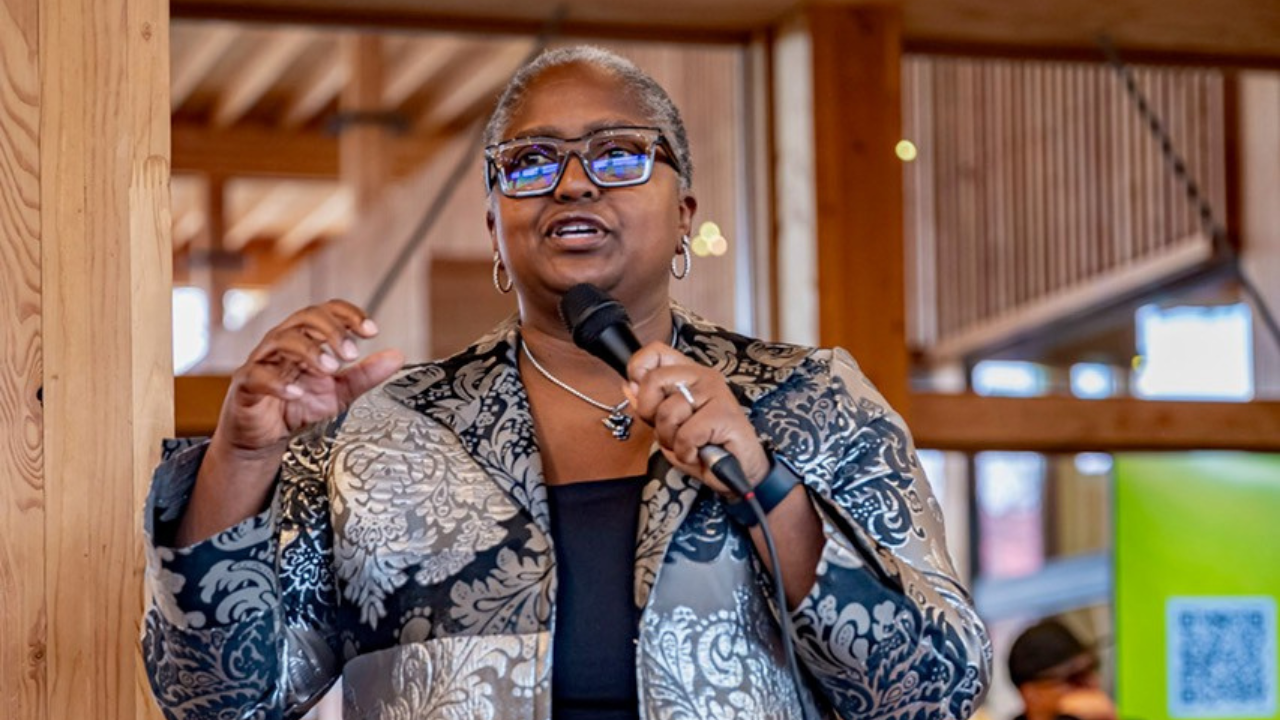
Monica Ray speaking at an event.
The first lesson from Ray’s work is the impact of igniting community pride. Residents rallied around an empowering theme to define their neighbourhood. Today you’ll see it everywhere, even stencilled on walkways: Soul of the City. As Ray describes it, “People felt like true, authentic Washington, DC lived in this part of the city... We were in this constant fight for the soul of the city, and that's how the name happened.”
Seven years later, it was adopted as the moniker for the area’s first Business Improvement District (BID). “The city's investment in [St. Elizabeth’s] was just a spark that we needed to really catalyse investment in this part of the city,” she explains.
“Soul of the City” began as an act of pride reclamation in 2019; by 2026, Ray frames it as necessary but no longer sufficient. “Soul is not about colour. It’s about a feeling. It’s about that pride and that sense of who we are… I think our goal [in 2019] was simply to be seen… to make people know that we existed… The kids taking stencils and creating ‘Soul of the City’ on the sidewalks — they had developed the pride before we even had things we were proud of necessarily. Now our job is how do we turn that pride into real power.”
Today, Ray defines success as having enough organisational power to shape local investment instead of just reacting to it: “People need to see the vision. They need to see some real wins… For 25, 30 years, we were saying these things are coming, but there was no evidence... If there’s a lesson in how to keep people engaged, it’s to always reinforce and give them some tangible evidence of change.”
Fighting waves of political and systemic inequities is a powerful test of faith. “I attended a rally recently,” Ray recounts, “and an older woman — she’s probably 80 — stood up. There had been all these firebrand speakers before her, racial equity and voters’ rights all on the table. She stood up and said, ‘I just want to start by saying I’m sorry.’ The crowd went totally silent. She said, ‘I’m sorry because we thought we had fought these battles 40 years ago. I’m so sorry that you find yourselves still fighting those very same battles’. There are times when I feel exactly the same way about community development.”
Monica Ray stares down quick fixes as well as cynicism. “I spoke at a programme on Juneteenth, and I talked about how in 1865 the laws had changed, freedom had been declared, but there were still people who had no idea they were free. I think our communities are very similar. The world is changing around us, but we’ve not yet seen the evidence of that change. We just can’t rely on a meeting or a flyer or a survey. We have to depend on deep relationship. It’s got to be consistent. We have to show that the change is happening because we have to show up.”
Her focus on fortifying collective agency while acknowledging decades of community trauma is essential: “What we try to empower our residents to believe is that even if those things are true, we have the collective power to change it.”
Making sure development happens with residents rather than to them is a marathon, not a sprint as Ray explains: “If we have not figured out a way to harvest the wealth that will come from development in a way that helps us preserve our community, we failed.”
A vital lesson for all leaders is that every generation needs to embrace, and define, its place on its own terms. “Now, success is the transfer of power for me. That’s a lofty job... How do we move from this heroic effort to a durable system that generations can benefit from, that I probably won’t get to meet? I’ve also begun kind of a public narrative of how important it is to not die with a torch in your hand.”
Ray describes the up-and-coming cohort of community organisers as, “eager fighters. They are not going to back down. They’re far more emotionally intelligent than I ever was at 25 and 30... they are as engaged as any other generation. It just looks and feels different.”
Unlocking the potential of Congress Heights was never a given; the path was rocky and treacherous in many ways. “I like to talk about divine interruptions,” Ray quips, “That’s been our secret sauce —when the plan that we laid did not go according to plan, that interruption is really what fuelled change.”
But Monica Ray’s decades-long commitment to “deep relationships” with her community, her peers, and a cadre of loyal partners has led to a remarkable metamorphosis for a place that had been dismissed by many as unredeemable. Her most potent advice may be this: “Trajectory matters more than starting place. My starting point was really, really dismal — disinvested, no connection, no ownership. And now that trajectory is power... I think I lived that quote.”