How reputation cuts borrowing cost: An analysis of sovereign risk premiums

By Leonard J. Ponzi, PhD, Natalia Arenzana Arias, PhD., & Fernando Prado Abuín
Partners, Reputation Lab
Ask most executives what their company’s reputation is worth, and the answer tends to drift toward the intangible: trust, goodwill, brand love, a line in the annual report. An honest answer is more concrete. Reputation shows up on the balance sheet, and the clearest proof of it has just arrived from an unlikely place – the global bond market.
A new analysis of the 2026 RepCore Nations study, which measures the world’s 60 largest economies as seen through the eyes of the public across the G7, ties a country’s reputation to two outcomes that move real money: the interest it pays to borrow and the willingness of people everywhere to visit, study, work, buy, and invest.
This pattern is the most rigorous public test of an idea that should matter to every reputation leader: that country reputation is not a soft asset but a financial one, and that it is reflected in the sovereign risk premiums the country pays. Debt is the hardest place to hide. It is priced continuously by professional investors with their own capital at stake, judged against decades of fiscal data, and stripped of sentiment. It is the same as corporate reputation, i.e., investors, customers, and employees make the same kinds of support choices.
Reputation and the cost of borrowing
The cost of capital is simply the price of money. Companies are generally judged by their home government’s creditworthiness, so corporate loans, infrastructure projects, and even household mortgages tend to move with the sovereign rate.
For a country, the rate its government pays to borrow is the foundation on which almost every other rate is built. When a government borrows more cheaply, even a few tenths of a percentage point shaved off the national premium is not a one-time saving; it lowers the cost of capital across the entire economy, freeing up money for investment rather than interest payments.
When examining the RepCore Nation results, the pattern is clear: the better a country’s reputation, the less it pays to borrow (see Figure 1). Switzerland, Norway, Canada, Denmark, Sweden, and the Netherlands rank among both the most admired countries and the cheapest to lend to. At the other end, countries with weaker reputations, such as Iran, Pakistan, Russia, and Egypt, pay far more to raise the same money. Across all 60 economies, reputation and the ratings-based borrowing premium move together, with a correlation of -0.55. Compared with the market price of ensuring a country’s debt against default, the sovereign CDS spread shows an even stronger link, at -0.67. (The data analysis is discussed below)

Figure 1: Each dot is one of the 60 largest economies. Stronger reputation, lower borrowing cost.
Selective labeling to show approximate location
This is not simply a story about rich countries. Wealthier nations naturally score better and borrow more cheaply, so the analysis tested whether reputation still mattered after accounting for a country’s income. It did. With national income held constant, reputation maintains an independent, statistically significant relationship with the borrowing premium (standardised coefficient -0.27, p < 0.01), and the model explains about three-quarters of the variation across economies. Reputation carries its own weight, over and above wealth.
How much does country reputation weigh? A one-standard-deviation lift in reputation is linked to roughly a 0.4 percentage point reduction in a country’s borrowing premium. In more practical terms, on a 200-billion-dollar national debt, that is about 0.8 billion dollars in interest every year. For a finance minister, reputation is not a vanity metric. It is a line item.
Now, in the context of a corporate boardroom meeting, a company’s reputation operates on the same machinery: it shapes the rate at which investors fund it, the discount the market applies to its risk, and the confidence of rating agencies and lenders who set its cost of debt. The currencies differ, but the mechanism is identical. A reputation that lenders trust lowers financing costs, whether the borrower is a country or a corporation.
Strong reputation? What will the world do for you?
Reputation not only lowers what an entity pays out. It also raises the question of what the world is willing to give. In reputation management, we refer to this as supportive behaviour. Since 2024, the RepCore Nations study has asked whether respondents would recommend a country, visit it, live there, work there, study there, attend an event, buy its products, and invest in it. There is a total of ten distinct statements of support. Across all of them, the responses track reputation with correlations greater than 0.9.
The alignment is close to one-to-one (see Figure 2). In plain terms, reputation does not merely shape how a place is admired in the abstract; it closely predicts whether real people will spend their money, their study years, and their careers on it. Willingness to invest is the bridge back to the borrowing story: it rises in near lockstep with reputation. The same standing that lowers the price of a country’s debt also raises private appetite to put money to work there. One reputation, working both sides of the ledger: cheaper money coming in, and more of it too.
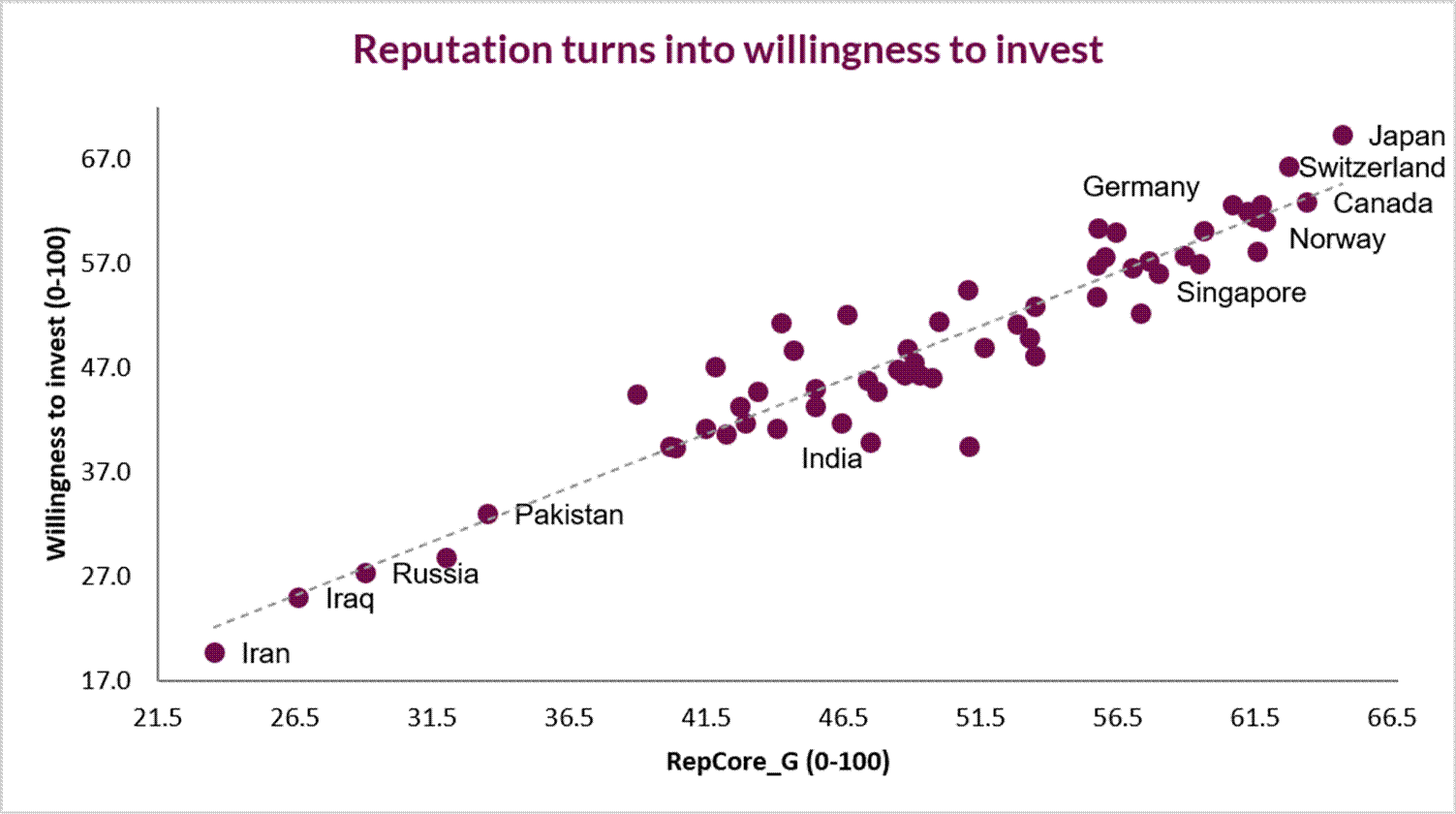
Figure 2: Willingness to invest rises almost in lockstep with a country’s reputation.
Selective labeling to show approximate location
From CCO to CMO to country brand managers, this is the part that should feel familiar. Recommend, buy, invest, join, trust: these are precisely the stakeholder behaviours a communications and marketing function seeks to earn and often measures with KPIs. The sovereign analysis just shows the relationship in its purest form, free of advertising spend and promotional noise. Simply said, reputation is a lever that moves customers, talent, and capital. When implemented correctly and consistently, stakeholders will support you in ways most can only envy.
How do we know this: What’s the evidence behind the claim?
Though leadership earns its name only when the method is open to inspection, it is worth being precise about what was measured, how, and what the numbers do and do not prove.
The Question
Does a country’s reputation convey information about the sovereign risk premium (i.e., the extra return markets demand to hold a country’s debt) beyond what macro fundamentals and credit ratings already capture?
The short answer is a qualified yes. Reputation is clearly linked to the borrowing premium and maintains an independent relationship even after accounting for national income, a principal macroeconomic fundamental. Fully teasing out the impact of reputation from the set of fundamentals and credit ratings is the next step, as discussed in the limitations section below.
The data: What were our inputs?
RepCore Nations - RepCore Score: The RepCore Score is the average reputation rating that the public in the G7 nations (the United States, Canada, the United Kingdom, France, Germany, Italy, and Japan) has given to each country. The 0-100 scale is adjusted for cultural bias. The analysis covers the 60 largest economies by GDP and is based on tens of thousands of individual ratings each year: roughly 42,000 G7 ratings in 2024, 58,000 in 2025, and 46,000 in 2026.
Supportive behaviour: Ten intention items in the questionnaire include whether a person would recommend visiting, living, working, investing, buying, studying, or attending an event in a country, and whether they would themselves visit, invest, or buy. Again, each is rated from 1 to 10, adjusted for cultural bias, and rescaled to a 0-100 range for reporting.
Sovereign risk: Two measures from (NYU Stern): the ratings-based default spread, available for all 60 economies, and the market sovereign CDS spread, the price investors pay to insure a country’s debt against default, available for about 50 of them. National income (World Bank GDP per capita) serves as the control for wealth. *
The method: What did it reveal?
Each country’s RepCore Score was compared with its borrowing premium, and the relationship was then tested again after accounting for income. The supportive-behaviour analysis was repeated on all three annual waves to check consistency. The headline results are summarised below.
| What we measured | What we found |
| Reputation vs the borrowing premium (ratings-based) | Correlation of -0.55 across 60 economies |
| Reputation vs the market price of default risk (CDS) | Correlation of -0.67 across 50 economies |
| Reputation effect after accounting for national income | Independent and significant (standardised coefficient -0.27, p < 0.001; the model explains about three-quarters of the variation) |
| Reputation vs each of the ten supportive behaviours | Correlation of 0.95 to 0.97 across 60 economies |
| Consistency across 2024, 2025, and 2026 data sets | Reputation-to-support link about 0.95 every year; reputation scores correlate 0.97 to 0.99 between consecutive years |
A one-standard-deviation increase in the RepCore Score corresponds to roughly a 0.39 percentage-point lower borrowing premium. The income-controlled model was estimated on the logarithm of the borrowing premium to keep a few very high-risk countries from dominating.
What does this establish, and what does it not?
The evidence shows that reputation conveys information about borrowing costs beyond national income. We recognise this research is limited in that it doesn’t isolate reputation from the full set of macro fundamentals (such as debt-to-GDP, growth, inflation, and reserves) or from credit ratings specifically, the ratings-based premium is itself derived from credit ratings. However, the findings presented here are strong evidence that reputation is associated with borrowing cost. Plainly said, the relationship is real and recurring. Nonetheless, we are looking for clients to help us explore the next phase of this research to determine, by taking into account a full set of macro fundamentals, exactly how much of the borrowing cost is attributable to reputation.
What does this mean for the CCO, CMO, and country brand managers?
If reputation shapes both the cost of capital and the flow of customers, talent, and investment, it deserves to be managed as an economic asset rather than treated as a communications afterthought. For the leaders accountable for it, there are four implications:
- Put reputation in the room where money is discussed. Its effect on the cost of capital and on demand means it belongs in the conversations about financing, valuation, and growth strategy, not only in the marketing plan. The reputation executives should arrive with the same fluency-based points that the CFO expects from any other steward of capital.
- Treat it as an early-warning signal. Because reputation and economic outcomes move together, a slipping reputation can be an early indicator of rising costs and cooling investor and customer interest. When tracked properly, it is a leading metric, not a lagging one.
- Build it during calm times. Reputation is earned slowly and serves as a buffer in a crisis. The time to invest is before the storm. The equity built during quiet periods is exactly what holds value and price steady when trouble arrives.
- Measure the return in both currencies. Track the payoff not only in a lower cost of capital but also in stronger demand: customer preference, talent attraction, pricing power, and investor confidence. These reputation outcomes, together with the two ledgers, capture their full return.
The sovereign data makes the argument unusually hard to dismiss. When the world’s most disciplined buyers, bond investors, are willing to accept a lower return to hold the debt of a well-regarded country, they are paying real money for reputation. The executives who can show their own organisation’s reputation working both sides of the ledger, lowering the cost of capital while raising demand, have moved the function from the cost column to the value column. That is where the evidence says it belongs.
Glossary of key terms
- RepCore Score. The headline country-reputation measure in the RepCore Nations study; here, the average rating from the G7 public on a 0 to 100 scale.
- Supportive behaviour. Stated willingness to act in an entity’s favour: to recommend, visit, study, work, buy, or invest.
- Sovereign risk premium. The extra interest a country pays to borrow, above the safest borrowers, to compensate lenders for the risk of not being repaid.
- Default spread. A ratings-based estimate of that premium.
- Sovereign CDS. The market price of insuring a country’s debt against default; a continuously updated gauge of how risky lenders consider it.
- Macro fundamentals. A country’s core economic indicators, such as income, growth, debt, inflation, and reserves.
- Credit rating. A rating agency’s graded judgment of a borrower’s creditworthiness, which heavily influences the cost of borrowing.
- Cost of capital. The overall price an organisation or economy pays to raise money; the sovereign borrowing rate is its foundation.
- Correlation. A measure of how closely two things move together, from -1 (perfect opposite) through 0 (no relationship) to +1 (perfect match).
- Standardised coefficient. The size of an effect is expressed in standard steps, so different factors can be compared on the same scale.
*Sources: Aswath Damodaran, "Country Default Spreads and Risk Premiums," NYU Stern School of Business, updated January 5, 2026, accessed June 2026, https://pages.stern.nyu.edu/~adamodar/New_Home_Page/datafile/ctryprem.html. World Bank, "GDP per capita (current US$)," indicator NY.GDP.PCAP.CD, World Bank Open Data, accessed June 2026, https://data.worldbank.org/indicator/NY.GDP.PCAP.CD.
About
Reputation Lab measures and advises on country, city, and organisational reputation, and is the home of the RepCore Nations study. www.corporatereputationlab.com