Beyond the logo: How place branding became Kimba's economic development engine
By Mel Garibaldi, Economic Development Manager, District Council of Kimba
This article was originally posted in the Official Journal of Economic Development Australia.
Small regional councils face an increasingly complex challenge. We compete for investment dollars against metropolitan centres with larger budgets and greater market visibility. We work to attract skilled workers in an era of metropolitan migration. We seek to build tourism economies while our towns may lack "hero" attractions. And we do all of this with constrained resources and capacity.
The traditional economic development toolkit, like grants, incentives, and infrastructure investment, remains important. But in an attention economy where perception drives decision-making, there's a strategic lever many councils underutilise: place branding. This article examines how the District Council of Kimba transformed place branding from a marketing exercise into a strategic economic development framework that has fundamentally shifted how we attract investment, grow tourism, build cohesion, and shape policy.
Understanding place branding as an economic development strategy
Place branding is frequently misunderstood and dismissed as superficial: new logos, feel-good slogans, or expensive consultancy projects that deliver little tangible return. This scepticism often comes from councils that have invested in branding exercises that produced beautiful brand books but failed to drive measurable outcomes.
The difference lies in approach. Authentic place branding is not about creating an image; it's about revealing and amplifying the authentic story that already exists within a community. When executed well, place branding becomes a decision-making framework that provides clarity about what opportunities to pursue, how to communicate with investors and visitors, what infrastructure investments support the brand promise, and how to measure success. It answers the fundamental question every economic development strategy must address: "Why here?"
Place branding is particularly powerful for regional councils because it levels the playing field. We may not have the population base or funding of capital cities, but we can compete on story, authenticity, and identity – assets metropolitan centres often struggle to articulate.
The I'm Kimba journey
Kimba is a town of approximately 1,100 people located at the gateway to the Eyre Peninsula in South Australia. In 2023, Council recognised that while we were investing in infrastructure and services, we lacked a coherent narrative about who we are and where we're going. Conversations about economic development, tourism, and community identity were happening in silos. We had assets but no unifying story.
Discovery: Listening first
Our first decision was critical: we would not start with a designer or a consultant brief. We began with conversations. Over several months, we sat down with residents, business owners, sporting clubs, school students, farmers, and visitors. We asked simple questions: What do you love about Kimba? How would you describe this place to someone who's never been here? What do you want the future to look like?
What emerged surprised us. People didn't talk about challenges or limitations. They talked about resilience, opportunity, and connection. They described a community that looks forward, not backward. And one thing kept surfacing: Kimba wasn't just where they lived. It was part of who they were. An identity worn with pride.
Three insights shaped everything that followed: the brand had to be participatory, flexible enough to work across diverse contexts, and authentic to residents while remaining compelling to outsiders.
Design: Building a system
When we went to tender, we received several strong submissions. Our instinct was to work locally, or at least within South Australia. Surely a regional brand should be built by people who understand regional communities? But as we reviewed the proposals, a Sydney-based agency, SGK, demonstrated the clearest understanding of what we were trying to achieve. They got it. Not despite the distance, but because they approached our story with fresh eyes and genuine curiosity.
What followed became one of the most critical factors in our success: a deep, trusted partnership. SGK immersed themselves in our community, spending time understanding not just what Kimba is, but what it means, how people connect, how the community functions, what residents value beyond what they explicitly say. Strong place-branding outcomes require this level of insight and alignment. Without a consultant who truly gets it, you end up with beautiful design that feels hollow, or messaging that sounds polished but rings false to locals. The partnership allowed SGK to capture something authentic that we, being too close to it, struggled to articulate ourselves.
Together, we developed the I'm Kimba brand system. The framework centres on a simple, adaptable structure: anyone can complete the phrase "I'm kI'Mba. I'm…" with their own story.
- I'm Looking for Adventure (tourism)
- I'm Growing Opportunity (economic development)
- I'm a Community to Shout About (civic pride)
- I'm Built on Strong Foundations (heritage and agriculture)
This wasn't clever copywriting. It was strategic design thinking. The system gave the local bakery, the farming family, Council, and incoming investors the same toolkit to tell their version of the Kimba story.
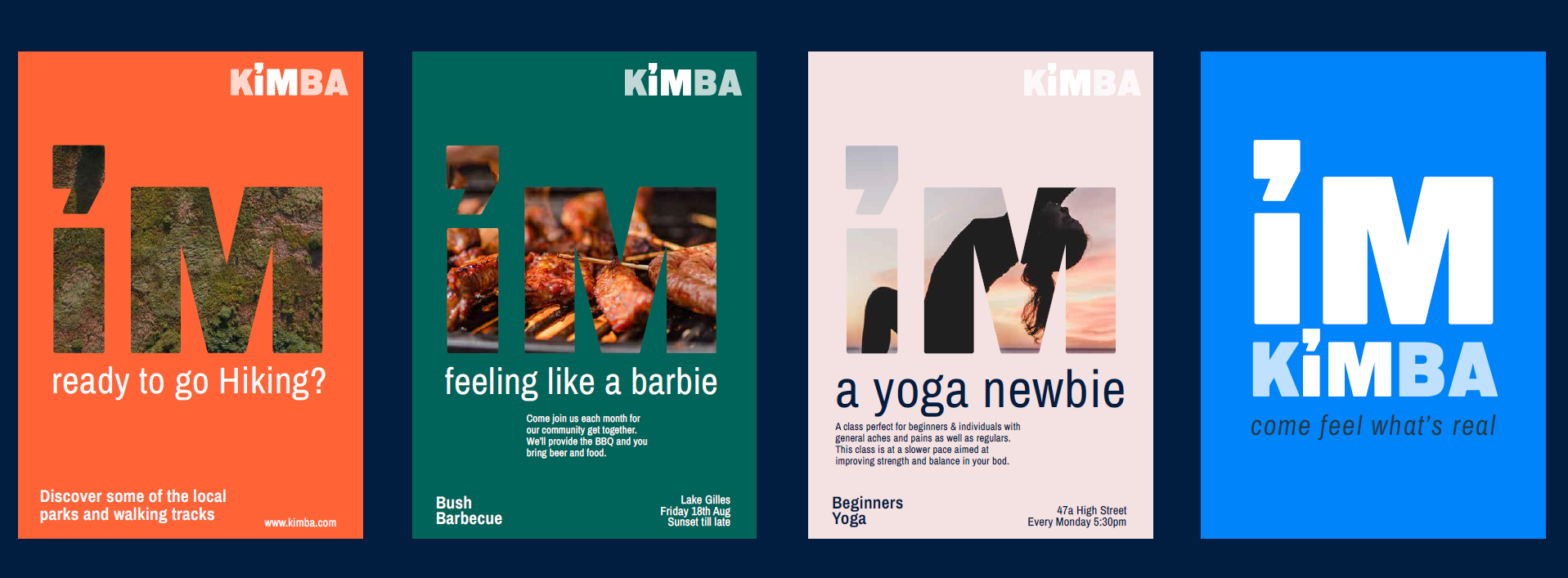
But this only works if people can actually use it. So, we invested in comprehensive brand guidelines and co-branding frameworks, making adoption straightforward for businesses and community groups. Too many place brands fail because adoption is complicated or tightly controlled. We chose the opposite approach: we gave it away freely and supported its delivery. Businesses and community groups could access templates, guidelines, and advice to help them use the brand confidently. This combination of accessibility and support encouraged creative interpretation within clear parameters.
Launch and evolution
Rather than a traditional Council-led launch, we seeded adoption through the community. Local businesses moved first. Shopfronts and social media profiles began displaying I'm Kimba messaging before Council had finished rolling out our own signage and communications.
The adoption wasn't universal or instantaneous, though. Some businesses embraced the brand enthusiastically; others remained focused on their own established identities. This is the honest reality of place branding: adoption is gradual and requires sustained encouragement.
But the most significant shift was internal. The brand began shaping strategic decisions. When evaluating economic development opportunities, we started asking: "Does this fit the I'm Kimba story?" It became a filter for strategic alignment - and the moment the brand moved from marketing asset to strategic infrastructure.
The I'm Kimba effect
Investment attraction
Investors make decisions based on data, but also on intangible factors like community readiness and local support. A strong place brand signals both. Since launching I'm Kimba, we no longer lead investment conversations with defensive explanations of our size or remoteness. Instead, we lead with identity: "We're Kimba - a community that's confidently growing opportunity."
The brand has made our investment attraction materials more compelling. Our investment prospectus, grant applications, and economic development documents all employ I'm Kimba language and visual identity. This consistency creates an impression of professionalism and strategic clarity. Perhaps most importantly, the brand creates a narrative container for multiple investment opportunities, allowing us to present them as parts of a larger story about Kimba's evolution rather than disparate projects.
Tourism development
Tourism in regional areas faces a specific challenge: how do you attract visitors to places without internationally recognised landmarks? The answer is storytelling and identity. I'm Kimba transformed our tourism approach from asset-based marketing ("we have a giant galah sculpture") to identity-based marketing ("we're an authentic regional community with stories, character, and genuine hospitality").
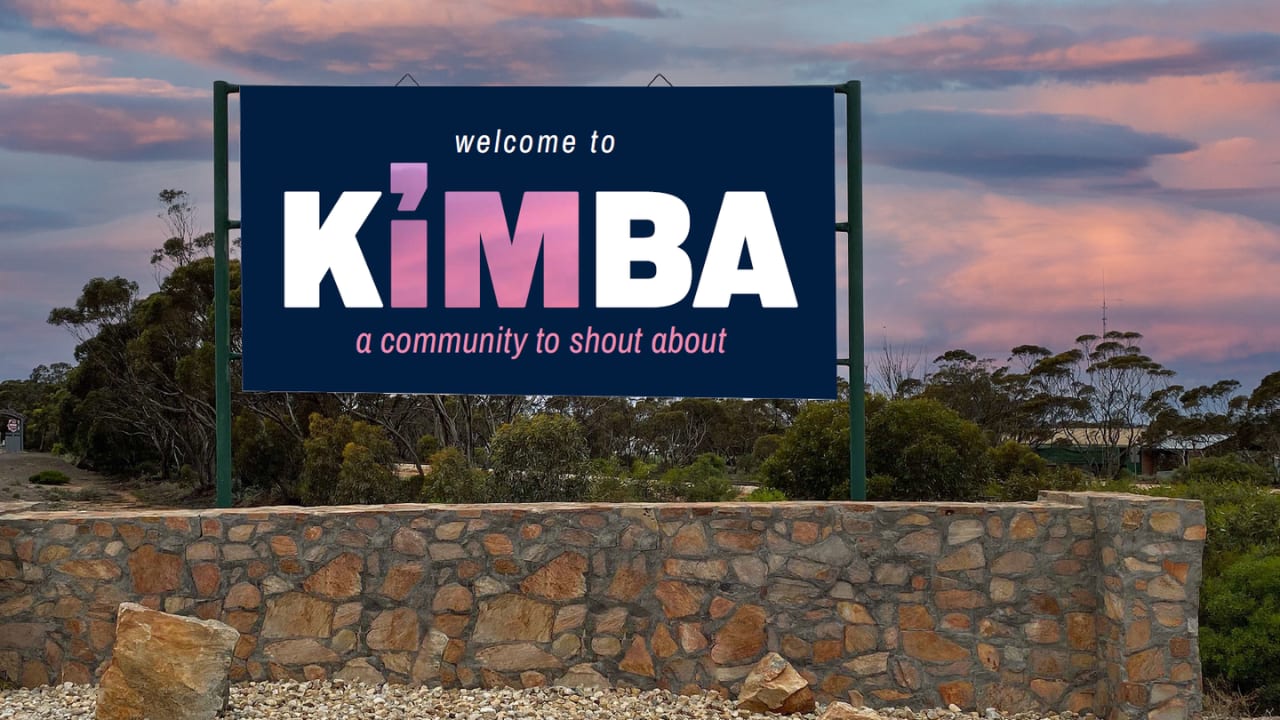
The brand also created consistency across the visitor journey. Our website, social media, roadside signage, visitor information centre materials, and Mainstreet wayfinding all employ I'm Kimba branding. This consistency builds trust and confidence. Visitors feel they've arrived somewhere intentional, not somewhere haphazard. A strong brand helps visitors instantly recognise what makes the place unique, sets expectations, enhances engagement, and leaves a lasting impression, ensuring the journey feels coherent, authentic, and compelling from start to finish. Exit surveys indicate visitors describe Kimba as "welcoming," "interesting," and "worth the stop", all language that mirrors our brand positioning.
The co-branding guidelines allow cafes, accommodation providers, and tour operators to align their own marketing with the broader Kimba narrative, creating a multiplier effect. When a visitor sees consistent messaging from Council, local businesses, and community groups, it reinforces the sense of a cohesive, authentic destination.
Community cohesion
The process of creating I'm Kimba was as valuable as the product. Community engagement activities sparked conversations about values, identity, and aspiration. The act of co-creation built ownership. Since launch, we've observed increased civic participation and engagement. While causation is difficult to prove definitively, the correlation is striking. When people feel proud of their place, they become more invested in it and actively connected to it.
The brand also provides a tool for celebrating success and building optimism. Each time we announce a new development, we frame it through I'm Kimba language, creating a positive narrative feedback loop that reinforces ownership, pride and participation.
Strategic alignment
I'm Kimba now influences decisions across Council operations. Our Strategic Plan explicitly references I'm Kimba positioning. Major projects were communicated using I'm Kimba language, helping build community support and clarifying how infrastructure investments fit into Kimba's identity. All Council communications employ consistent brand voice and visual identity.
The strategic value lies in clarity and consistency throughout every channel and interaction. Economic development requires alignment across multiple stakeholders and timescales. A strong brand provides the common language and shared vision that enables this alignment.
What we learned
Authenticity starts with listening
The single biggest mistake in place branding is starting with a design before you understand your community's authentic identity. Authenticity is non-negotiable. If long-time residents don't recognise themselves in the brand narrative, it will fail.
Invest significant time in discovery. Run community workshops, interview stakeholders, and survey residents. Ask open-ended questions: What makes this place special? How do you describe your town to outsiders? Treat this phase as a community engagement strategy, not just research for a design project. The conversations you have while creating the brand will build relationships and trust that persist long after launch.
Leadership commitment determines longevity
Elected members and senior management must understand that branding is strategic infrastructure, not cosmetic marketing. This requires education, evidence, and patience. We invested time bringing Council along the journey, demonstrating how brand language improved grant applications and investor conversations by creating a clear and unified voice that builds trust and credibility before expecting full buy-in.
Without this support, the project will struggle to gain traction or sustain momentum through implementation challenges. Place branding delivers compounding returns over years, not months. If your council is only willing to invest for 12 months, pause and plan for a longer term approach.
Design for flexibility and democratic adoption
The most successful place brands are systems, not single logos. I'm Kimba works because it's a template anyone can personalise while keeping the brand and the messaging intact. Systems that are too rigid or complicated discourage use.
When developing your brand identity, prioritise multiple applications, ease of use, and adaptability. Invest in comprehensive brand guidelines and co-branding toolkits. Map the entire visitor journey, from first online search to departure, and identify every touchpoint where your brand can create consistency. Then give businesses and community groups the resources to align their own marketing with your broader narrative. Make adoption as seamless and effortless as possible.
Embed the brand everywhere
A brand that exists only in tourism brochures has minimal economic development impact. Branding cannot live only in communications or marketing departments. It must permeate strategy, operations, and partnerships. Your brand is not just for tourism; it's your investment value proposition.
Unexpected places to embed your brand: grant applications and funding proposals, employment materials, Council meeting agendas, infrastructure planning documents, and community consultation processes. Build staff capacity across all departments to understand and apply brand principles in their work. Educate economic development staff specifically to use brand language naturally in investor pitches and proposals.
The more ubiquitous the brand becomes, the more it shapes organisational culture, community perception, and external stakeholder relationships.
Measure, learn, and be honest
Without evidence of impact, branding remains faith-based. Establish metrics that matter: awareness (do people recognise your brand?), adoption (how many businesses are using it?), perception (has external perception changed?), and outcomes (visitor dwell time, investment inquiries, grant success rates).
Review these metrics regularly and be willing to adapt. Be honest about what's working and what isn't. Our adoption wasn't universal, but by acknowledging this reality, we could focus efforts on sustaining momentum where it existed rather than pretending everything was perfect. This data not only justifies continued investment but identifies where you need to evolve.
Where to begin
For those thinking about a similar journey, a few thoughts on where to begin:
- Build leadership endorsement before you start. Present place branding as economic development infrastructure, not marketing expense. Share case studies and evidence. Without elected member and CEO support, the project will struggle to gain traction or sustain momentum through implementation challenges.
- Begin with discovery, not design. Ensure thorough community engagement is completed before starting the design phase. Host workshops across different demographics, interview key stakeholders, survey residents and recent visitors and really listen to understand the communities values and aspirations. Document what makes your place genuinely distinctive: the stories, values, and aspirations that already exist.
- Assemble a small steering group. Include Council staff (economic development, communications, tourism), 2-3 elected members, and 3-4 community representatives (business, education, community groups). This group guides the process but doesn't control outcomes. The broader community must shape the brand identity.
- Commit to the long game. Place branding delivers compounding returns over years, not months. If your council is only willing to invest for 12 months, pause and plan for a longer term approach The real value emerges when the brand becomes embedded in strategy, influencing decisions and perceptions over time.
From identity to impact
Eighteen months after launching I'm Kimba, the brand has fundamentally transformed how Kimba operates, communicates, and competes. It has become the thread connecting our economic development strategy, tourism marketing, community engagement, and strategic planning. When we speak with investors, we have a compelling story. When visitors arrive, they experience a genuine and cohesive identity. When residents engage in community projects, they see themselves reflected in a shared narrative of progress and pride.
Being finalists in the 2025 EDA award validated what we already knew: authentic place branding, executed strategically and embedded comprehensively, is powerful economic development infrastructure. It's particularly valuable for regional councils because it levels the competitive playing field. We can't outspend metropolitan centres, but we can out-story them.
For economic development professionals sceptical about branding or let down by past superficial attempts, the lesson from Kimba is simple: branding fails when it's cosmetic, but succeeds when it's strategic. When branding emerges from genuine community identity, when it's designed for democratic adoption, when it's embedded in strategic decision-making, and when it's measured for impact, it becomes one of the most cost-effective economic development investments a council can make.
I hope something here is useful for your own journey. Regional Australia faces real challenges, and I genuinely believe we're stronger when we share what works. Place branding isn't about pretending to be something you're not. It's about articulating, celebrating, and strategically leveraging who you already are. For Kimba, that identity has become our greatest competitive advantage.
About the author
Mel Garibaldi is the Economic Development Manager for the District Council of Kimba. The I'm Kimba place branding campaign was a finalist in the Economic Development Marketing & Promotional category at the 2025 Economic Development Australia awards. She's always happy to chat with fellow practitioners about place branding, economic development, or the joys and challenges of working in regional towns. Reach out at mel.garibaldi@kimba.sa.gov.au.