What is a place story and how to find it

By Dr Natasha Norman, co-founder, INSTID Institute for Identity
‘Story’ is today’s hot word in place branding.
In the UK, several public tenders for the creation of place ‘stories’ are running as we speak, including in Cambridgeshire and South Yorkshire. Last week, the British government announced a competition for towns and cities of culture. It stipulated ‘your story – the unique story of the town’ as the first application criteria (the others were having a culture development programme and the ability to deliver it).
Yet, ‘story’ is a broad word, and its application to ‘place’ is not immediately obvious. Intuitively, many identify it with the USP, the ‘unique selling proposition’ of the place. This is generally right, but start thinking USP, and it quickly leads on to ‘facts’, from where it is only a short leap to “the best place to live, work, study, and play’. This is where most places seem to end up these days. This ubiquitous slogan, even if resonant at home, will not win you any ‘city of culture’ competitions – nor do anything to develop your place brand. Because it is not a story.
What is a place story?
Let’s explore what a place story is. The Oxford Dictionary defines a story as ‘an account of past events or of how something has developed’. Merriam-Webster says it is ‘background information that clarifies a situation or affair’. A story, therefore, carries an explanation – here is its relevance to a place.
A place story is arguably ‘an account of the way of life in this place’. It is how the place makes people behave, and what this leads to, both tangibly (production) and intangibly (culture). What kind of people thrive here? What it takes to succeed here? What makes a good neighbour? What behaviours are not welcome? Todd Babiak, a philosopher of place branding, defines a place story ‘as a cultural expression of a place’, where culture is understood with a small c, as the ideas, customs and social behaviours.
If this sounds abstract, try this. Put yourself into your audience’s shoes. Imagine you could choose where to live, free from constraints of work, finance, or family. What would be important? You will probably think of the landscape: city or country, shore or hills. You would consider the sunshine and rainfall. You would know if you preferred to be among a friendly and engaging community, or among people who just ‘live and let live’. A good place story will answer these questions.
Here are some examples:

Source: South Australian Story
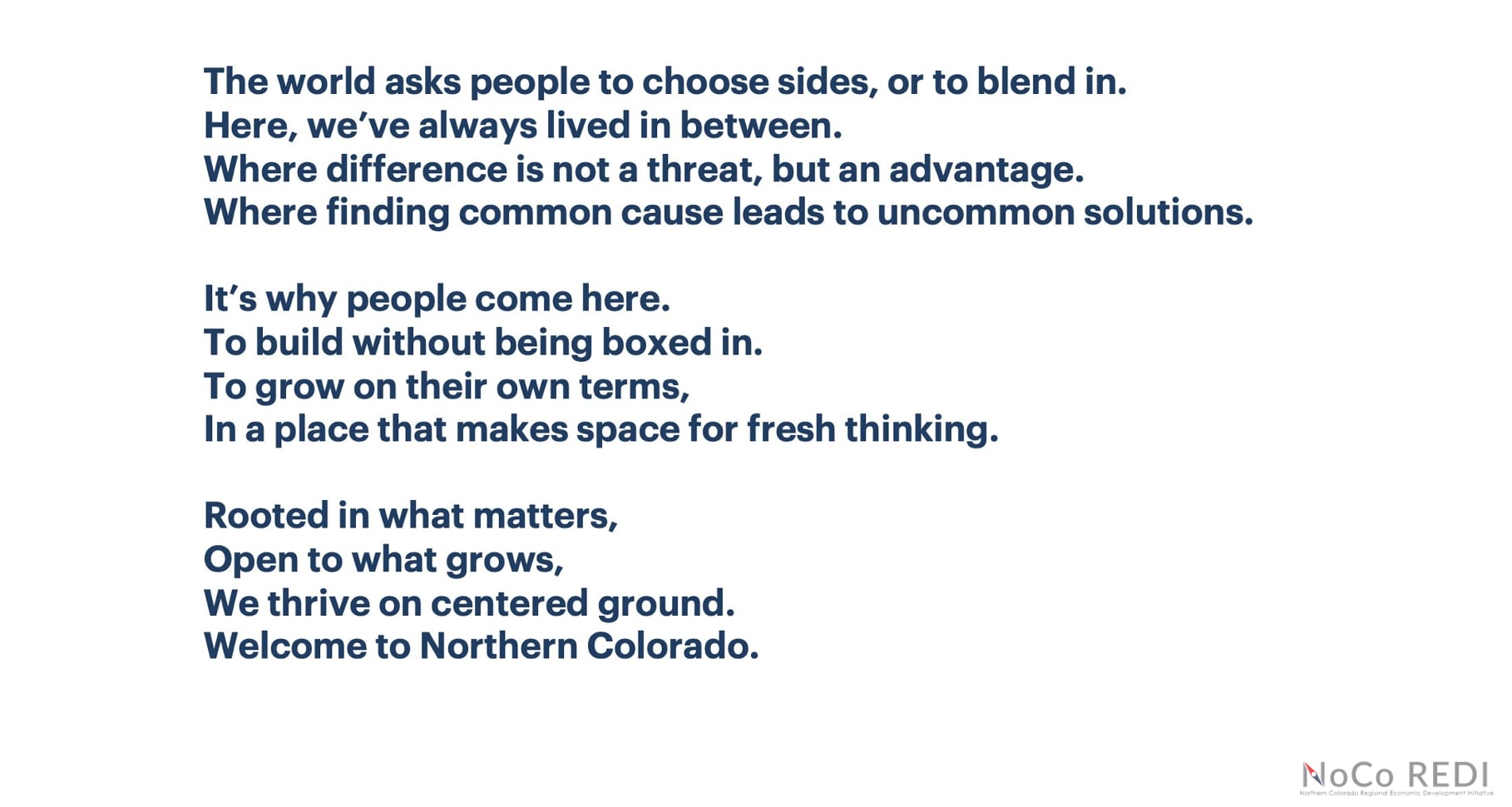
Source: North Colorado REDI
What is not a place story?
A simple rule of thumb to tell if you have a story is to check if it is not a list. A list is not a place story, not matter how many beautiful beaches, historic buildings or famous people are on it.
A list is just a sequence of items. Lists can be long or short, and any item can be added or taken without impact. You can say: ‘we are X, and Y, and Z, and also N and B.’ Why not also ‘M’ and ‘T’? What if someone forgets ‘N’ and ‘B’? No matter how many items you add, a list will not make a story. There will be no meaning, explanation, account of.
In a story, each sentence may not make sense on its own, but together they add up to create a coherent whole. A place story may not have a beginning, middle and end, as in fictional stories, but it builds towards a certain clear meaning, or an image of a place and how it functions. Its elements complement rather than contradict each other (e.g. revolutionary and caring). It creates a premonition of experience: what would it be like to live in this place or work with its people.
Understanding what a place story is and isn’t puts you on a footing that so many others miss. Those who list their assets stay shallow and ubiquitous. Those who proclaim common human values: we are friendly, open, generous, etc – staying equally generic. You want to occupy the middle ground between pure facts and a random list of general human virtues. You need to be specific and consistent.
At INSTID our business is place stories, and here is how we do it, or at least how we begin.
How to write your place story
The clue to understanding your story is observing your own place. No two regions, cities and even towns (maybe villages) are the same when you dive deep enough into their geography, history, and climate. These three factors define, limit and direct the way of life in a place, and what it produces.
Examine your place through these lenses:
- Geography and landscape: plains or mountains, quality of soil, the sheer size of the place dictate what is possible or not. Fertile lands historically favour individualistic thinking. Crowded or sparse spaces foster collective actions: kids raised by a village sort of thing. What people took out of the land two centuries ago (minerals or produce) or were not able to take (in mountainous regions) still affects how people live here now.
- Climate is equally important. Harsh climates tend to produce people who are good at teamwork. Too much or too little sun directly translate into lifestyles, such as siestas and late-night dining (Spain) or mastering the art of cosying up (Denmark’s hygge).
- History is less linear but hugely influential. Has your place been a crossroads of war, as has much of Eastern Europe, encouraging scepticism and aloofness? Or was it a trading spot, a busy and loud mix of cultures? Or maybe it was set up as a utopian paradise? The echoes of events gone by will resonate in the behaviours or attitudes of today.
You may wonder if you are the right person to capture all this, and your day is busy enough. In fact, you know more than you think, but if you need help, do the following:
Instead of organising workshops to ask people what makes them special (get in touch and I can explain why this does not work), find an anthropologist, a local historian, an interested local journalist – any informed expert, and ask them to observe the place for a week or two. Get them to talk to your salt of the earth residents – as well as those who have ‘made it’ in your place. Tell them to capture your place’s ‘how’ rather than its many ‘whats’. Then write it up. You can also try and figure your place personality type by starting with the Place Compass quiz.
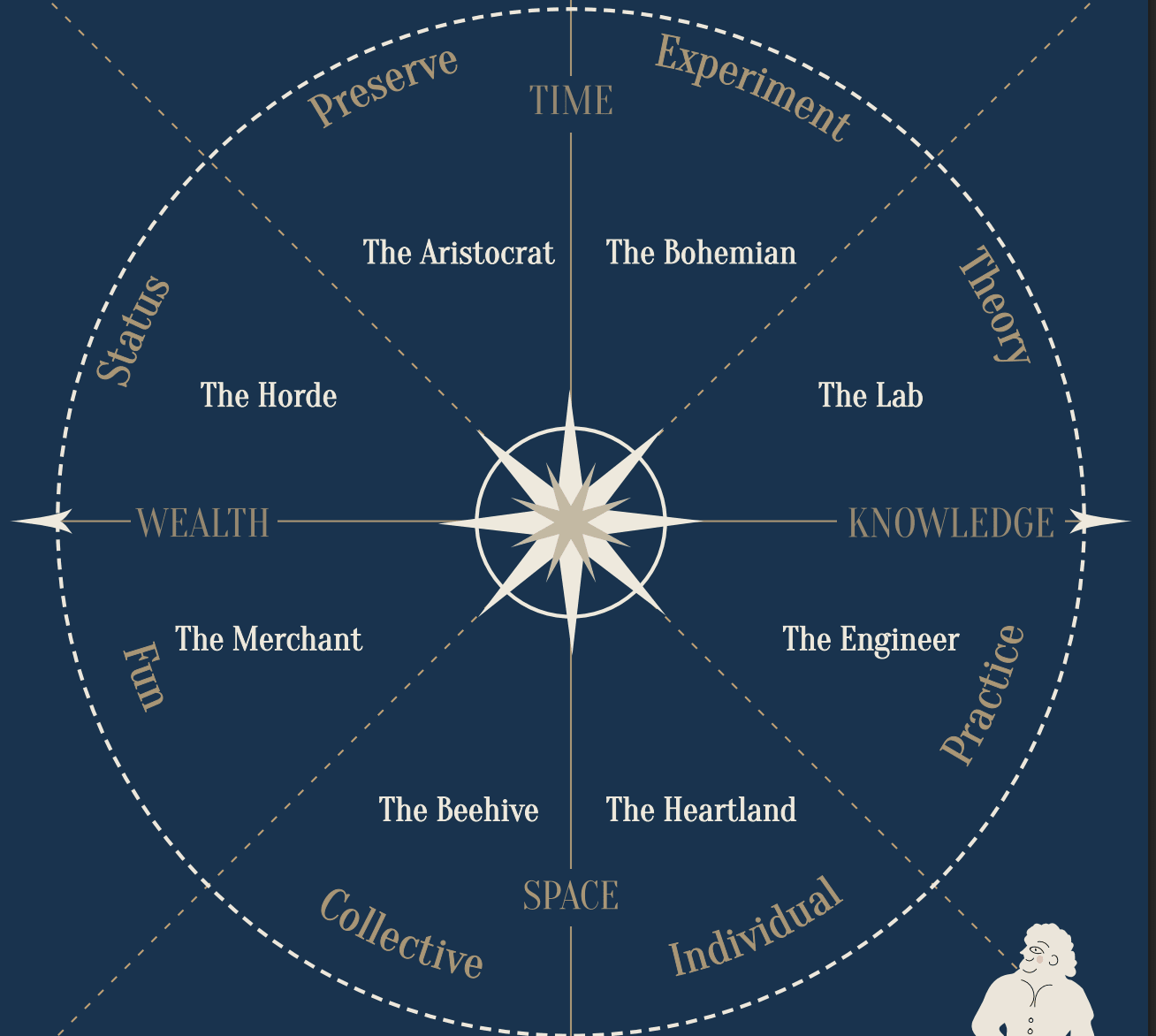
Finding your story can be simpler and cheaper than you think: you do not need perception surveys, and co-creation comes from deep conversations, not brainstorming workshops. Instead, it requires courage to invest in unfamiliar thinking. Take confidence from the model place brands, winners of City Nation Place Awards, that consistently punch above their weight (e.g. Finland, Estonia, Costa Rica, Tasmania) – these places have done deep soul-searching and have distinct stories that feed their campaigns and actions year after year.
What a story can do for your place
The place story, ultimately, is a life philosophy captured in a paragraph or a line of text. Amplify and apply this philosophy – and strategy and tactics will take care of themselves.
On the strategy side, knowing your place story is like knowing yourself: what strengths to amplify, and what is not worth developing. Places that run like clockwork should provide knowledge and assurance (e.g. Switzerland) and not compete in arts. Bohemian places that thrive on chaotic creativity should not pretend to be solid business hubs.
On the tactics side, a place story gives your place practical tools to grow and change. Tasmanians used their story to solve their literacy problem the Tasmanian way – through excellence. The Gold Coasters are reducing transport congestion – through inventiveness. Northern Coloradans are finding ways to manage exponential growth and strain on resources – through their ability to find a middle ground. And South Australians have produced the best tourism campaign design globally (as acknowledged by the City Nation Place 2025 award) by working on it collectively.
On the communication side, a place story gives flavour to your claims. What place does not see itself as creative or innovative? You will be able to explain why, and how – or stop saying it because you realise these are not your strengths.
Whether you are considering applying for the ‘city of culture’ competition or not, it is never too late or too early to think about your place story. Everything begins with it.
Find out more at: www.instid.org/theplacecompass