The future of perception: Nation and city branding 2026-2030

By Jose Filipe Torres, CEO, Bloom Consulting
Over the past five years, the world has seen an unprecedented acceleration of geopolitical tension, technological disruption, and societal transformation. These forces will reshape how countries, regions, and cities are perceived in the near term and they will continue to redefine the strategic priorities of nation and city branding well into the next years and decade.
Nation and city branding is increasingly, about anticipating change, preparing for volatility, and aligning policy with the evolving expectations of global audiences.
Looking ahead to 2030, emerging trends will place significant pressure on the Bloom Consulting 13 Perception Elements for Countries and 12 for Cities within the Bloom Consulting Taxonomy Model © the elements that ultimately shape how nations and cities are perceived.
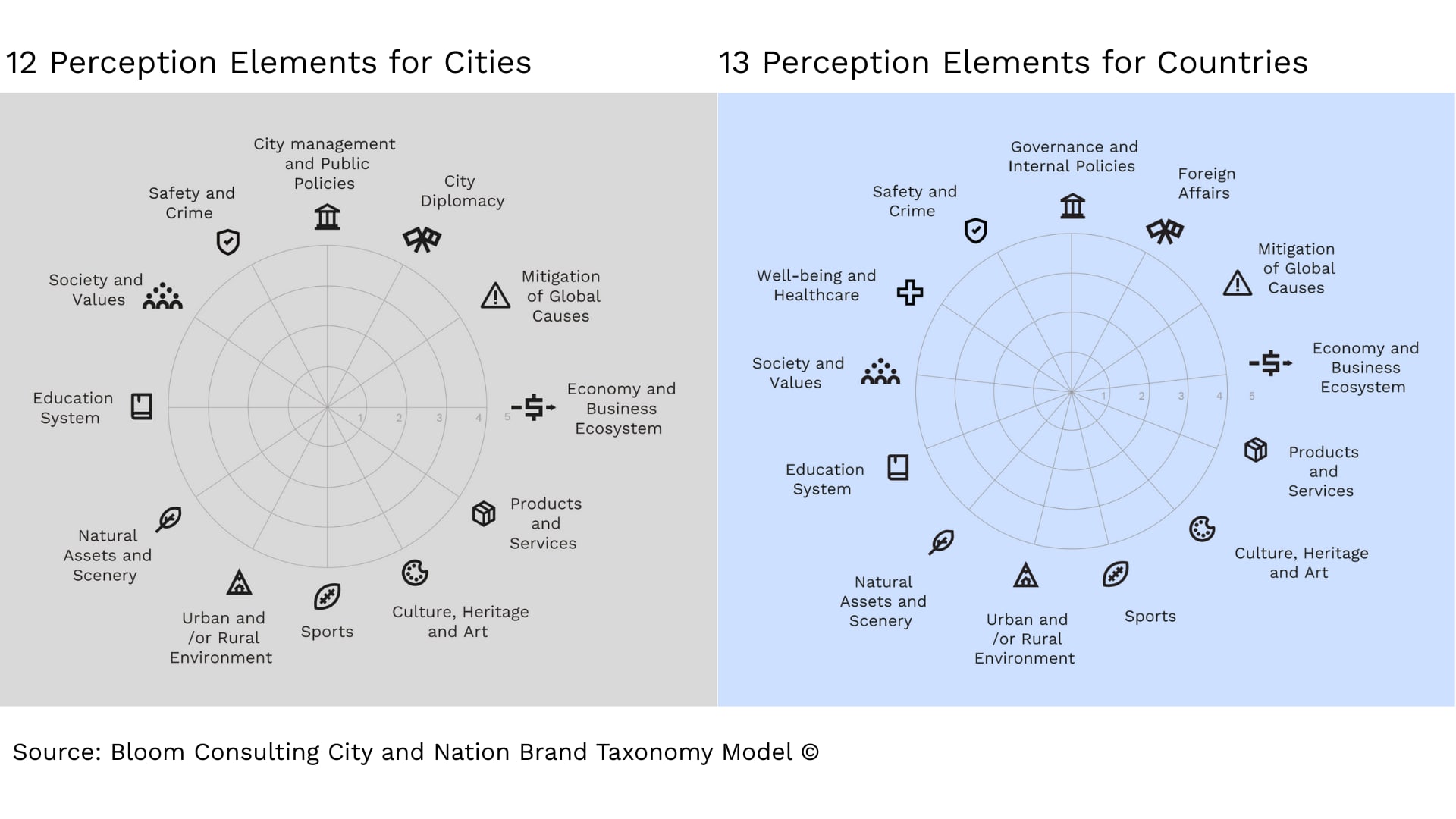
The objective is not to argue which elements are most “important” in the abstract, but to anticipate which Bloom Consulting Perception Elements will be under the greatest pressure over the next five years.
For a city or nation, a negative global reputation is no longer simply an obstacle to tourism; it is a structural vulnerability that adversaries can weaponise. As Professor Nicholas Cull noted at CNP Global 2025, this has become a matter of “reputational security.”
Within the Bloom Consulting Taxonomy Model ©, we understand place perception as a living ecosystem shaped through two pathways:
- Influence (the narratives of a place mainly through and in Digital Identity of Nation and City Brand 2.0)
- Experience (the reality global audiences encounter once onsite or when experiencing a product or a service from a specific place).
This analysis focuses on the first pathway - Influence - because exposure will matter more than ever through 2030, and because both dynamics will become increasingly intertwined.
Perception Elements under the strongest pressure until 2030
Methodology
Our analysis utilises a Dual-Axis Framework. This model allows for a high-fidelity assessment of a brand’s standing by plotting it against two critical vectors that determine which Perception Elements will be under the strongest pressure until 2030:
Axis A: Media Exposure.
(Higher organic media and social media exposure)
This measures the volume, sentiment, and velocity of a brand’s presence across traditional and digital landscapes, this is how perceptions will be shaped and it identifies which Perception Elements of a nation or city will have higher exposure until 2030.
Axis B: Misinformation Susceptibility.
(Which will be more vulnerable to misinformation)
This assesses the vulnerability of a brand, or its target audience, to AI poisoning, algorithmic bias, and co-ordinated disinformation campaigns. It measures how easily a brand's narrative can be hijacked by external actors until 2030.
Perception Elements under the strongest pressure until 2030 - Results
The news distribution model will continue to destabilize
Reuters Institute analysis points to continued economic headwinds for news, intensifying platform dependence, and the disruptive role of AI interfaces that answer queries directly reducing referral traffic and reshaping how stories are packaged and prioritised. This favors short formats, sharper angles, and emotionally salient narratives, conditions that systematically amplify certain Bloom Consulting Perception Elements (like safety, governance, foreign affairs).
The rise of synthetic media
The spread of AI-generated audio/video and deepfake content raises the probability of fast-moving reputational shocks, especially in areas tied to fear, identity, or legitimacy. UNESCO has framed this as a growing integrity challenge (crisis of knowing) that affects the reliability of evidence and trust.
Countries and cities must analyse not just what the world thinks, but how those thoughts are being manufactured, requiring a deep inquiry into the Perception Elements that define a place’s digital and physical footprint.
The period between 2026 and 2030 is therefore a defining moment for the governance of place brands. This article takes a forward-looking view grounded in research, expert insight, and Bloom Consulting’s ongoing work with countries and cities worldwide. (See the final section for details on how the results were calculated)
And here are the main conclusions and Perception Elements place branders need to pay special attention to:
For countries
The Critical perception elements:
- Governance and Internal Policies
- Foreign Affairs
- Society and Values
- Safety and Crime
 | Governance and internal Policies remains a high-exposure element due to the focus on Ethics. The "Integrity Gap" where a government’s actions contradict its democratic promises is now the primary target for narrative weaponization by adversaries. |
 | Foreign Affairs sits at the apex of exposure. In an era of real-time conflict reporting, a nation’s brand is often hijacked by external geopolitical events. This forces places into a reactive branding stance. |
 | The concept of Safety and Crime has been redefined. It is no longer measured solely by physical crime rates but by Informational Integrity. As the primary vector for global perception, "Safety" is driven by fear-based engagement. |
 | Society and Values. This dimension is the frontline of Culture War narratives. Internal social friction is a brand vulnerability. When a society is perceived as fractured, external adversaries leverage these to project an image of systemic instability. |
When comparing countries and cities, it is evident that country Perception Elements will be subject to greater pressure overall, yet several city Perception Elements will also face high pressure.
For cities
The Critical perception elements:
- City Management and Public Policies
- City Diplomacy
- Safety and Crime
| City Management and Public Policies has transitioned into a high-stakes visibility vector. The efficiency of a city’s infrastructure, specifically its Smart Infrastructure integrations, Climate Change resilience or Liveability driven policies or the lack of them will have a high media exposure |
| City Diplomacy while other perceptions elements become susceptible to viral misinformation and social media friction, City Diplomacy operates at the Systemic and Worldview levels. It is built upon peer-to-peer institutional relationships, B2B networks, and structured trade missions. These frameworks provide a Truth Anchor that is difficult to hack or disrupt through external narrative weaponization. For a city, a robust network of international municipal partnerships and bilateral trade agreements creates a layer of Perception resilience; the professional stakeholders within these networks rely on verified data and direct experience rather than the sentiment-driven fluctuations of social media. |
| In the urban context, Safety and Crime commands a maximum exposure score. While a city may be statistically secure, the virality of localized incidents on platforms like TikTok and Instagram creates a disproportionate impact. A single captured incident can bypass official data, triggering an algorithmic amplification that stains a city's reputation instantly. This viral crime phenomenon means city managers must treat safety not just as a policy goal, but as a high-stakes reputation management challenge where perception frequently overrides reality. |
How nation and city brand teams can prepare for the next years
The years, and perhaps the decade ahead will redefine what it means to build and manage a nation or city brand. External pressures will intensify, expectations will rise, and perceptions will become more volatile.
It’s important to highlight that nation and city branding will not only be a matter of managing risk or defending the Perception Elements that are under pressure, but also about managing and empowering the ideal Perception Elements that will bring positive perceptions to countries and cities.
Nation and place branding will remain, at its core, a governance practice that helps countries and cities navigate, in a systemic way, how to manage and empower perceptions and contribute to positive sentiment among global citizens. Nation and city brands that will thrive will be those that commit to long-term thinking, embrace the complexity of perception, and take Perception Elements seriously as strategic assets that shape economic, social, defence, and diplomatic futures, aligning their strategies to either defend or empower perception.
As we approach 2030, the mission for nation and city brand teams is clear:
To understand the forces shaping global perceptions, strengthen the Perception Elements under pressure, and leverage and empower those that drive positive perceptions by building the ideal portfolio of Perception Elements, not only to manage, but also to empower their nation and city brand.
As global transformation accelerates, people involved in the nation or city branding process must become more strategic in terms of building their image. Some of the most important strategic priorities include:
- Anticipate multiple futures
Geopolitical, environmental, and technological uncertainty require planning for different scenarios. The role of nation and city branding is not to guess the future, but to build strategies that remain relevant under several plausible pathways. - Integrate Digital Identity into strategic planning
Digital identity will become one of the primary determinants of perception. Nation and City Brand teams must ensure their online presence is consistent, credible, and aligned with objectives. - Strengthen governance
Nation and City Branding works best when there is stability and consistency over time. This means governments need teams that can work across political cycles, ensuring that policies, actions, and communication all move in the same direction. To achieve this, countries and cities need to build a governance model. - Measure perceptions with precision
Understanding how the 13 perception elements for countries and the 12 perception elements for cities evolve is essential for effective decision making. Measurement allows governments to identify which elements require policy intervention or strategic emphasis. - Build crisis management systems
Places that can evolve after crisis rather than return to pre-crisis conditions will perform better. This means focusing on adaptability, resilience, and long-term planning.
Sources used for this article
Triangulation and Data Integration
To populate these axes with empirical data, Bloom Consulting employed a process of Source Triangulation. This ensures that our insights are not based on isolated data points but on a synthesised understanding of global trends.
Axis A: Media Exposure.
(Higher organic media and social media exposure)
Synthesised data from the Reuters Institute to track news consumption shifts, the Atlantic Council to monitor geopolitical narrative trends, and GWI (Global Web Index) to capture real-time consumer sentiment and behavioural shifts in the experience economy as well as Bloom Consulting D2 - Digital Demand to map emerging trends in terms of search and appeal by global citizens
Axis B: Misinformation Susceptibility.
(Which will be more vulnerable to misinformation)
Integration of Pew Research Center’s studies on institutional trust, the UN Population Division’s demographic vulnerability data, and the World Economic Forum’s (WEF) Global Risks reports. These are further augmented by consumer foresight from WGSN/Kantar to identify emerging integrity gaps between a brand’s promise and its perceived reality as well as Bloom Consulting D2 - Digital Supply data to understand trends on who is shaping the Digital Identity of Nations and Cities
AI-Assisted Modelling and Data Integrity
This article’s projections are generated through Bloom Consulting’s proprietary, ring-fenced AI-assisted modelling. Unlike open-source models, the system operates in a closed environment and is trained and tested exclusively on verified datasets.